

On this page
Free to Download, Costly to Run
01
Notes
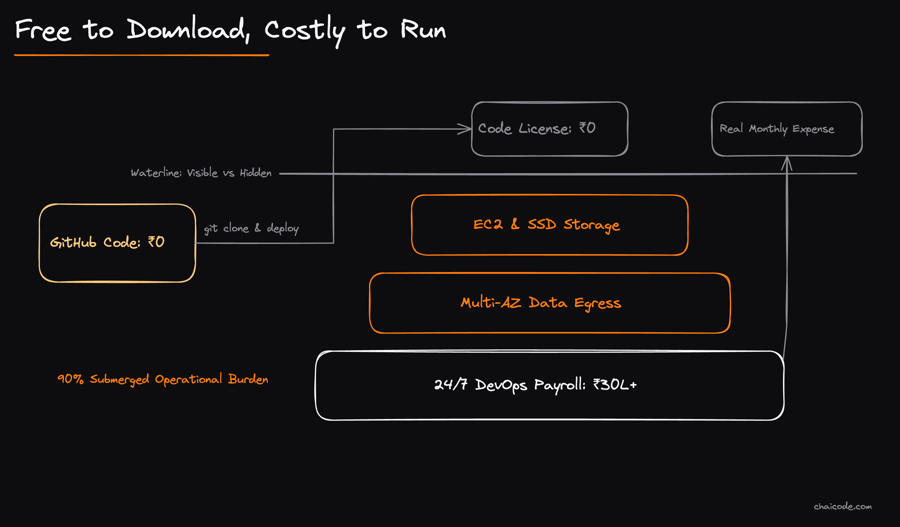
Open-source software is free like a stray puppy, not free like a complimentary cup of cutting chai.
You pay zero rupees to clone Apache Kafka from GitHub, but that ₹0 sticker price vanishes the moment you hit deploy.
Running Kafka for a Swiggy-like delivery tracking system demands round-the-clock compute servers, SSD storage, backups, and network bandwidth.
Assuming open source is automatically cheaper than cloud services ignores the massive hidden iceberg of operational overhead.
Kafka vs SQS: The Real Math
02
Notes
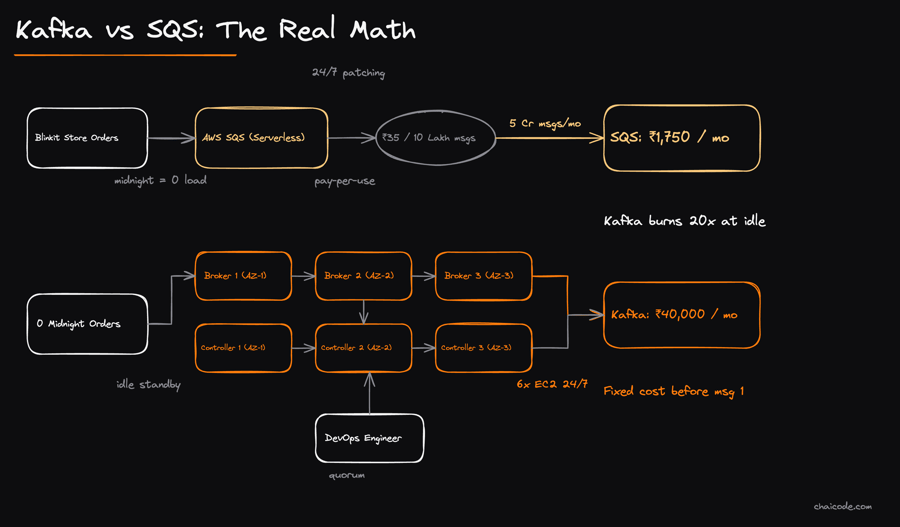
AWS SQS charges roughly ₹35 per 10 lakh messages, scaling completely down to ₹0 when your store closes at midnight.
A production-ready Kafka setup needs at least 3 broker servers and 3 controller nodes running 24/7 across three Availability Zones to prevent downtime.
Even before processing a single grocery order on Blinkit, your baseline Kafka server bill runs at ₹35,000 to ₹50,000 every single month.
For 5 crore messages a month, SQS costs barely ₹1,750, while idle Kafka infrastructure burns twenty times that amount just staying alive.
The Invisible DevOps Salary Tax
03
Notes
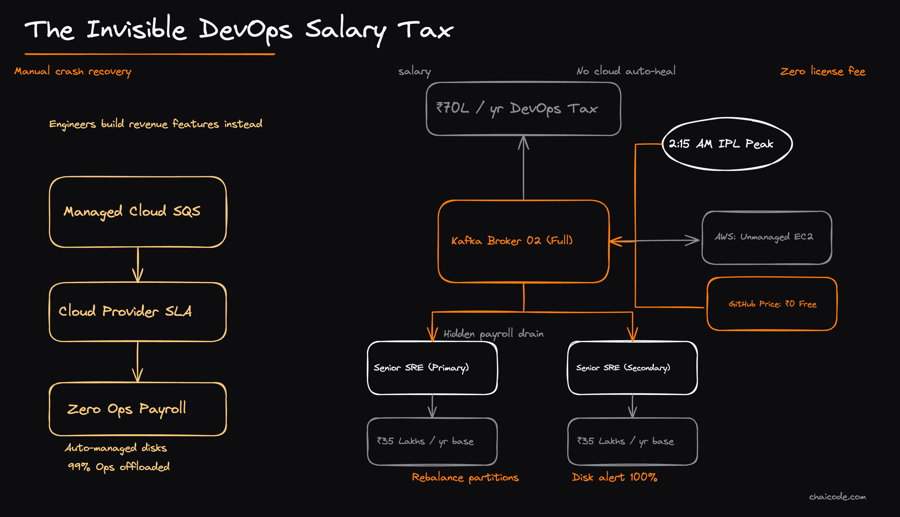
When a Kafka disk fills up at 2:00 AM during an India-Pakistan IPL match on Hotstar, AWS will not step in to save you.
You need at least two senior Site Reliability Engineers earning ₹35 Lakhs per year each on standby for upgrades, partition rebalancing, and crash recovery.
That adds ₹70 Lakhs annually in engineering payroll just to babysit a tool that carried a ₹0 price tag on GitHub.
Managed cloud services offload 99% of that operational headache to cloud providers, freeing engineers to build revenue-generating features instead.
The Licensing Trap: tldraw & BSL
04
Notes
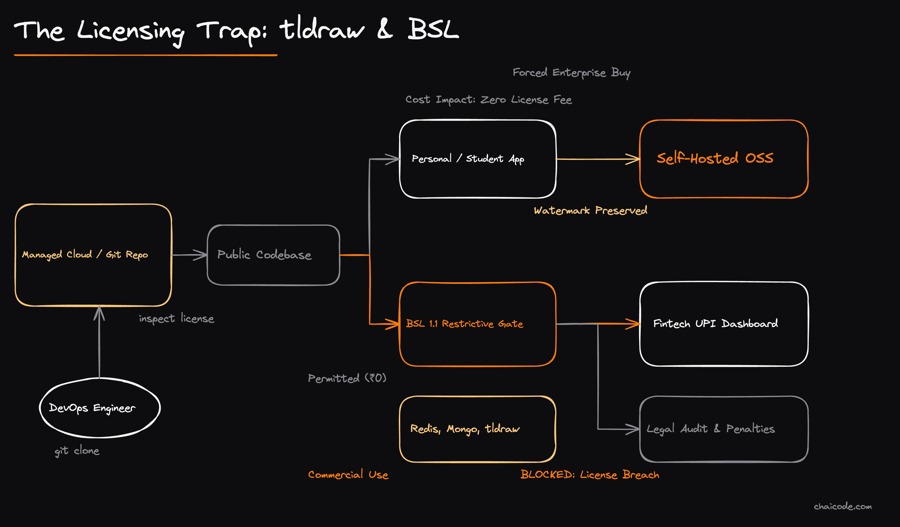
Developers often believe open-source code gives them permission to build commercial apps with zero restrictions.
Canvas libraries like tldraw look free on GitHub, but their commercial terms require paid business licenses if you remove their watermark or build enterprise tools.
Heavyweights like Elastic, MongoDB, and Redis abandoned traditional Apache 2.0 licenses for restrictive Business Source Licenses (BSL) to block free commercial exploitation.
If a Bengaluru fintech startup embeds these libraries blindly into their UPI payment dashboard, an audit can trigger severe legal penalties and forced licensing fees.
When to Self-Host vs Buy
05
Notes
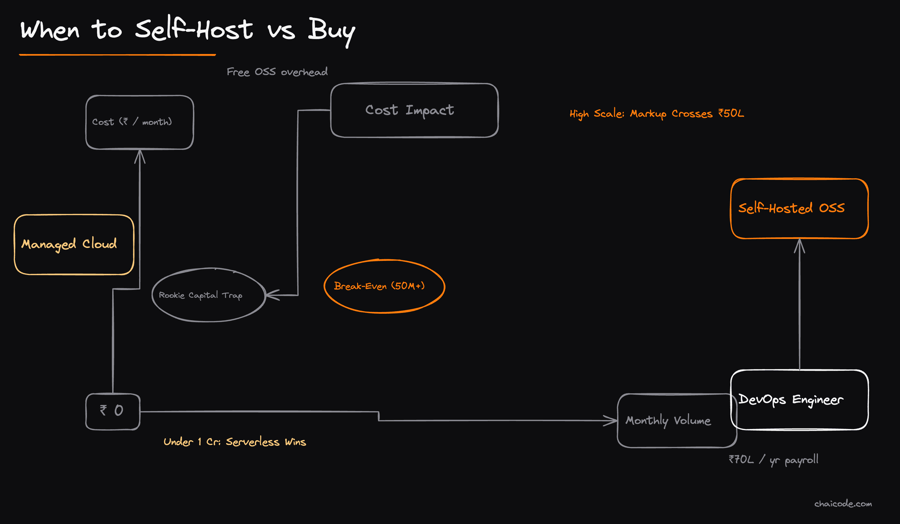
For early-stage startups handling under 1 crore events monthly, serverless managed tools like SQS, DynamoDB, and managed queues are far cheaper.
At massive scale—like PhonePe processing 700 crore UPI transactions a month—cloud vendor markups cross ₹50 Lakhs monthly, making dedicated SRE teams cost-effective.
Self-hosting only saves money when the managed cloud markup is significantly higher than the ₹70 Lakh annual engineering salary required to maintain it.
Defaulting to open-source software solely because the license is free is an expensive rookie mistake that drains company capital.