On this page
Welcome
01

Nobody Knows Every Single Command
02
Notes
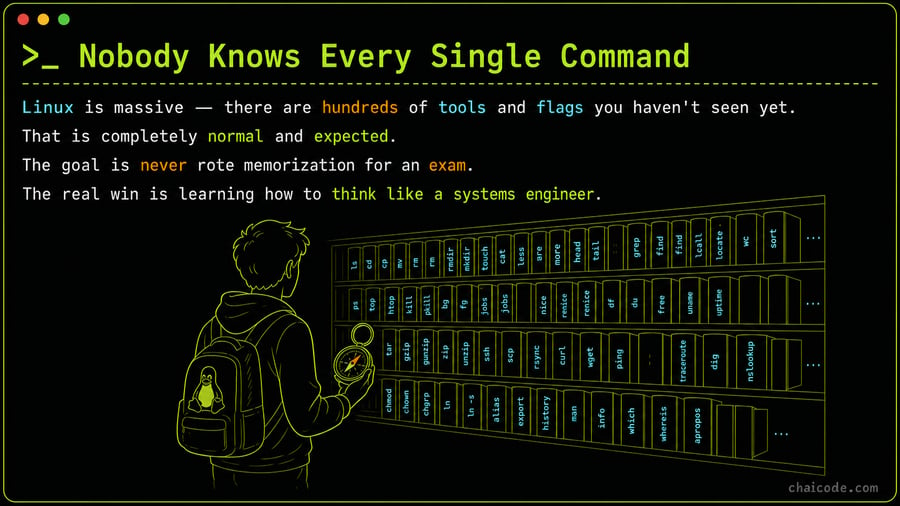
Linux is massive — there are hundreds of tools and flags you haven't seen yet.
That is completely normal and expected.
The goal is never rote memorization for an exam.
The real win is learning how to think like a systems engineer.
Understand the Map, Don't Memorize
03
Notes
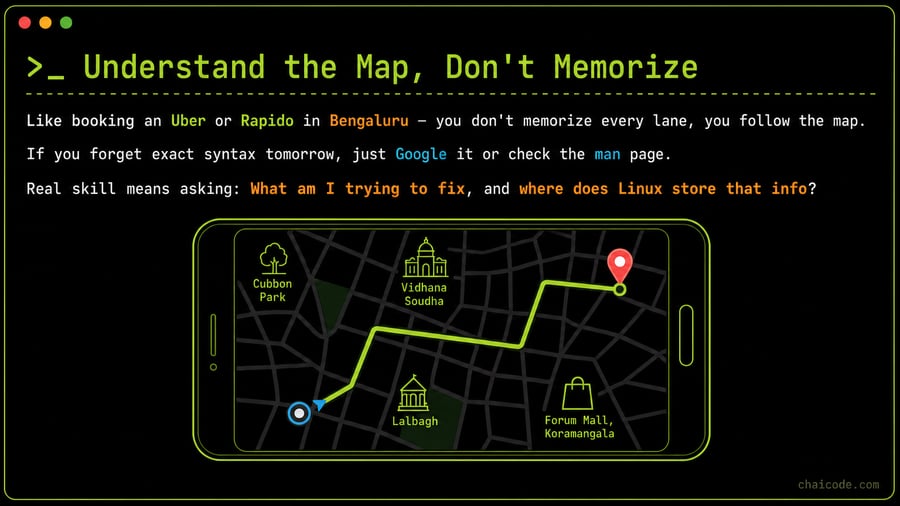
Like booking an Uber or Rapido in Bengaluru — you don't memorize every lane, you follow the map.
If you forget exact syntax tomorrow, just Google it or check the man page.
Real skill means asking: What am I trying to fix, and where does Linux store that info?
Linux Is Everywhere
04
Notes
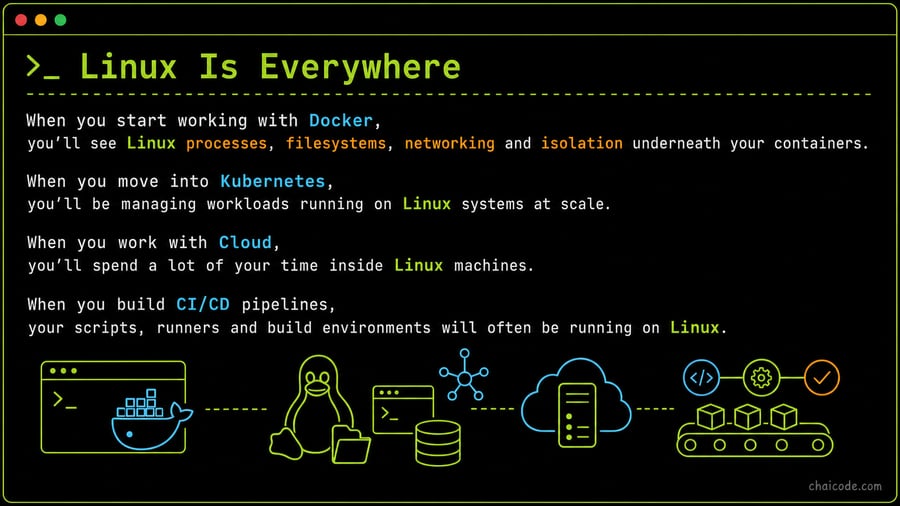
When you start working with Docker,
you’ll see Linux processes, filesystems, networking and isolation underneath your containers.
When you move into Kubernetes,
you’ll be managing workloads running on Linux systems at scale.
When you work with Cloud,
you’ll spend a lot of your time inside Linux machines.
When you build CI/CD pipelines,
your scripts, runners and build environments will often be running on Linux.
Troubleshooting When Things Crash
05
Notes
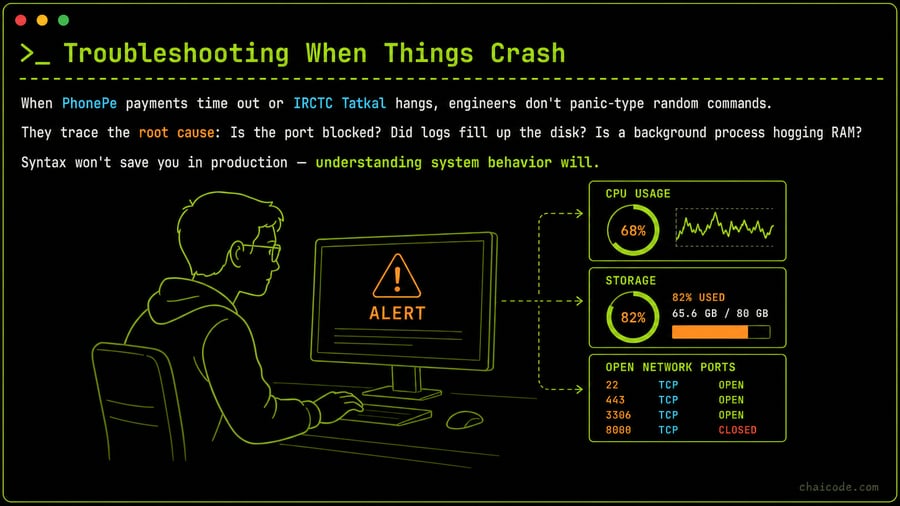
When PhonePe payments time out or IRCTC Tatkal hangs, engineers don't panic-type random commands.
They trace the root cause: Is the port blocked? Did logs fill up the disk? Is a background process hogging RAM?
Syntax won't save you in production — understanding system behavior will.
Linux is an Interconnected System
06
Notes
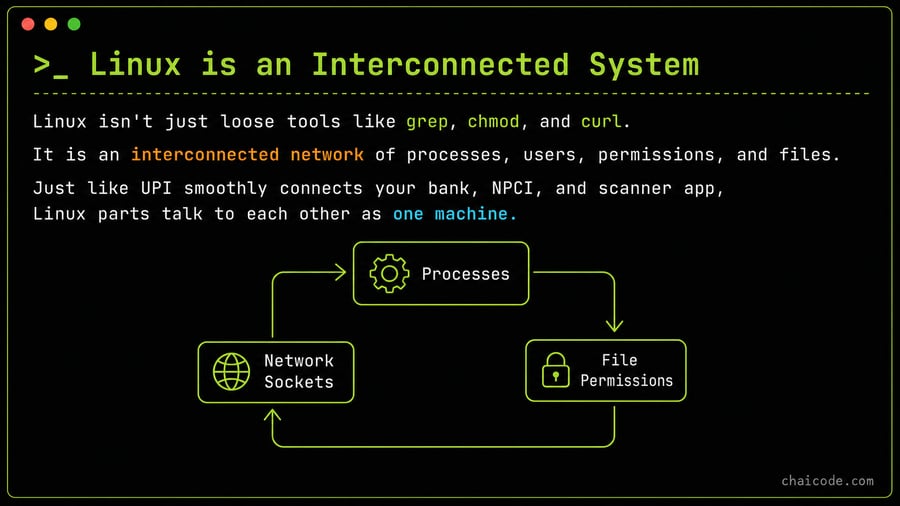
Linux isn't just loose tools like grep, chmod, and curl.
It is an interconnected network of processes, users, permissions, and files.
Just like UPI smoothly connects your bank, NPCI, and scanner app, Linux parts talk to each other as one machine.
Homework
07
Thank you
08