

On this page
- What's Inside an AI Model?
- The Biryani Pot Analogy
- What Are Open Weight Models?
- What Are Closed Weight Models?
- Open vs Closed: Key Tradeoffs
- Open Weight ≠ Open Source!
- Watch Out for License Traps
- How to Run Open Models Locally
- Open Weights on Managed Cloud
- The Economics: What Is Cheaper?
- The Harness: Engine vs Car
- Golden Rules for AI Builders
What's Inside an AI Model?
01
Notes
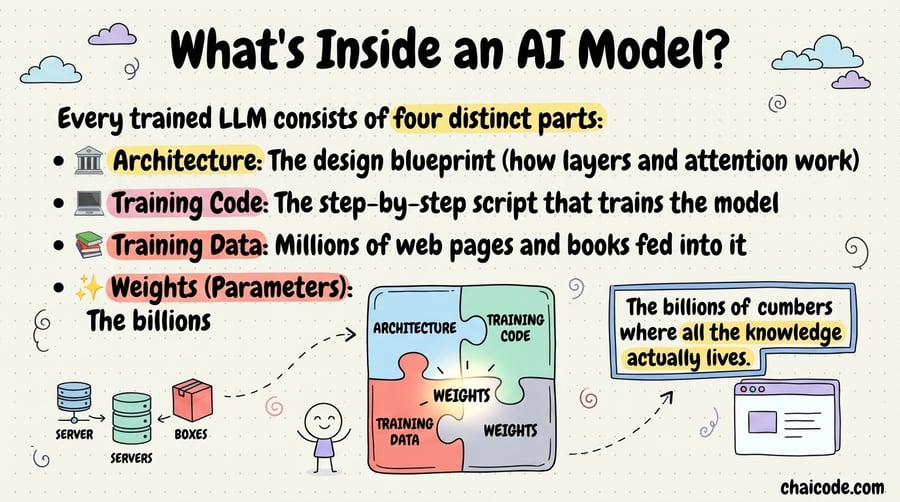
Every trained LLM consists of four distinct parts:
• Architecture: The design blueprint (how layers and attention work)
• Training Code: The step-by-step script that trains the model
• Training Data: Millions of web pages and books fed into it
• Weights (Parameters): The billions of calculated numbers where all the knowledge actually lives.
The Biryani Pot Analogy
02
Notes
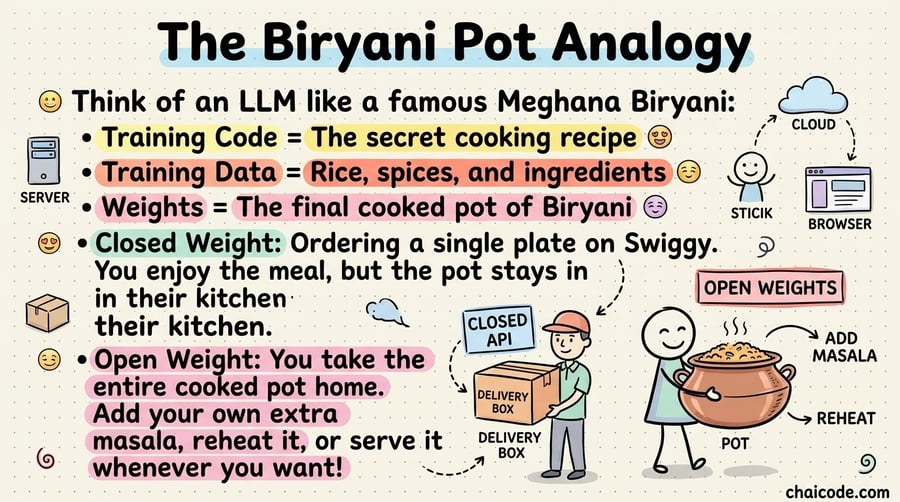
Think of an LLM like a famous Meghana Biryani:
• Training Code = The secret cooking recipe
• Training Data = Rice, spices, and ingredients
• Weights = The final cooked pot of Biryani
• Closed Weight: Ordering a single plate on Swiggy. You enjoy the meal, but the pot stays in their kitchen.
• Open Weight: You take the entire cooked pot home. Add your own extra masala, reheat it, or serve it whenever you want!
What Are Open Weight Models?
03
Notes
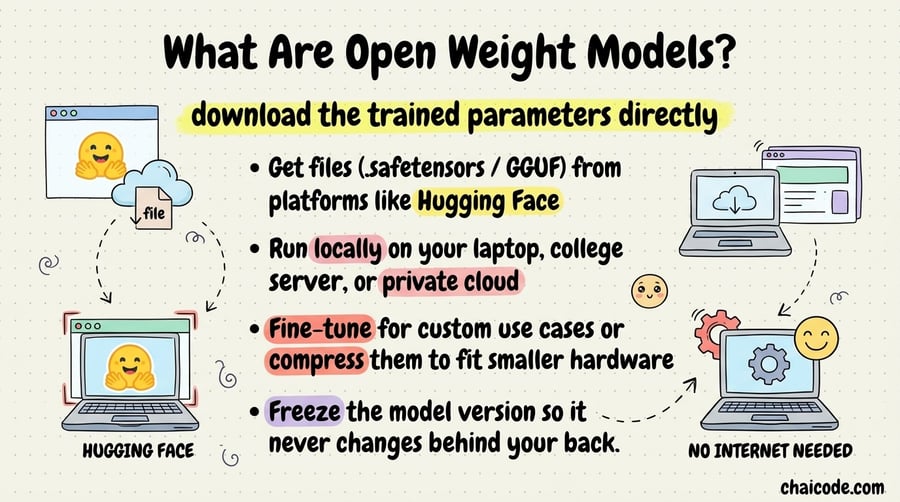
An open weight model lets you download the trained parameters directly:
• Get files (.safetensors / GGUF) from platforms like Hugging Face
• Run locally on your laptop, college server, or private cloud
• Fine-tune for custom use cases or compress them to fit smaller hardware
• Freeze the model version so it never changes behind your back.
What Are Closed Weight Models?
04
Notes
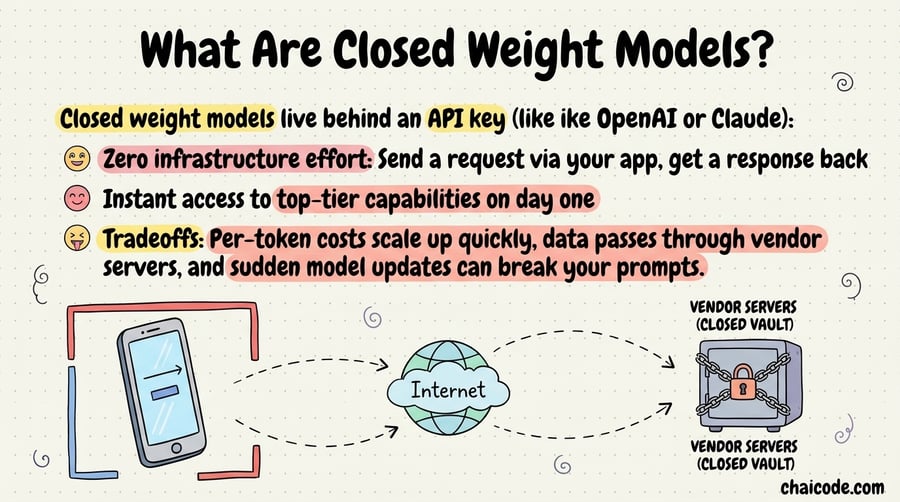
Closed weight models live behind an API key (like OpenAI or Claude):
• Zero infrastructure effort: Send a request via your app, get a response back
• Instant access to top-tier capabilities on day one
• Tradeoffs: Per-token costs scale up quickly, data passes through vendor servers, and sudden model updates can break your prompts.
Open vs Closed: Key Tradeoffs
05
Notes
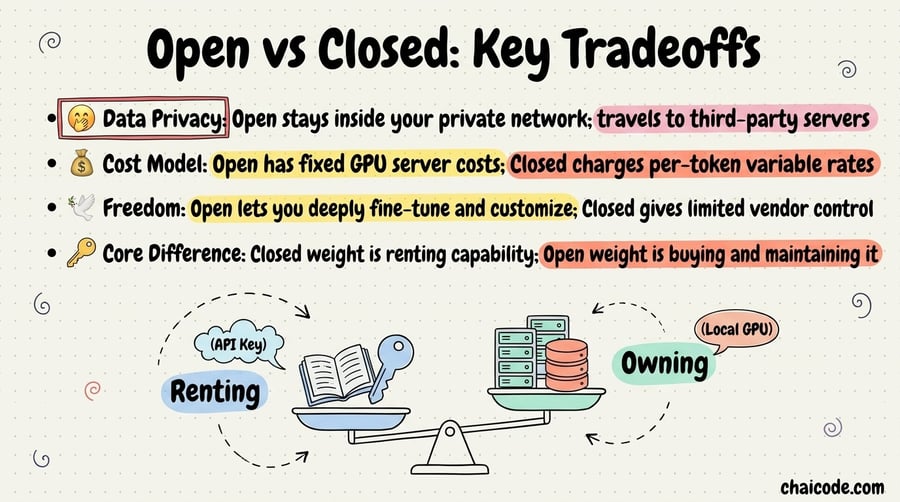
• Data Privacy: Open stays inside your private network; Closed travels to third-party servers
• Cost Model: Open has fixed GPU server costs; Closed charges per-token variable rates
• Freedom: Open lets you deeply fine-tune and customize; Closed gives limited vendor control
• Core Difference: Closed weight is renting capability; Open weight is buying and maintaining it.
Open Weight ≠ Open Source!
06
Notes
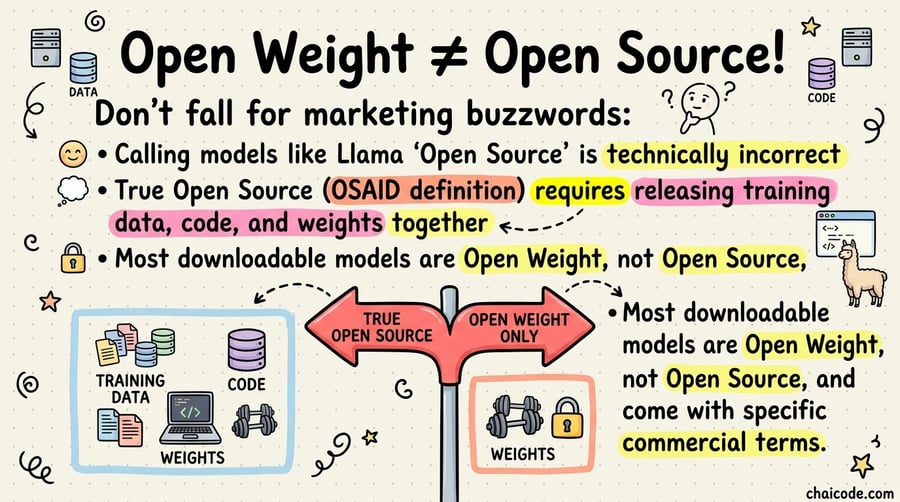
Don't fall for marketing buzzwords:
• Calling models like Llama 'Open Source' is technically incorrect
• True Open Source (OSAID definition) requires releasing training data, code, and weights together
• Most downloadable models are Open Weight, not Open Source, and come with specific commercial terms.
Watch Out for License Traps
07
Notes
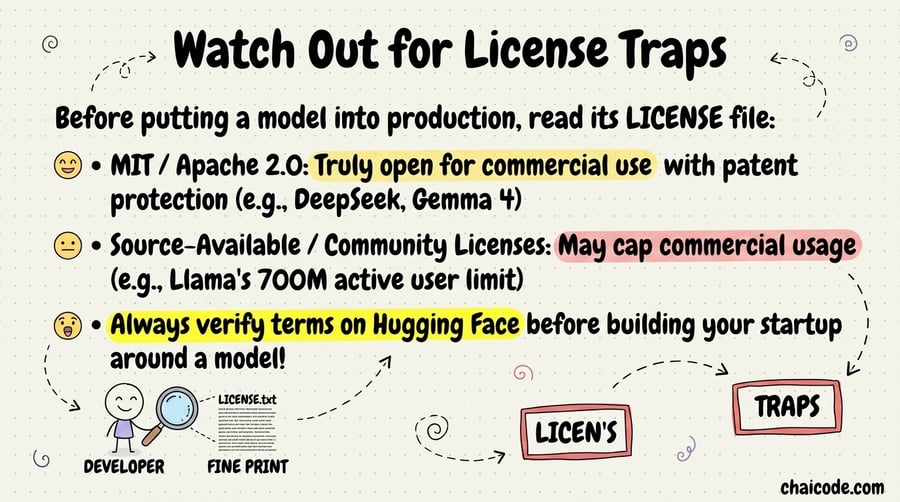
Before putting a model into production, read its LICENSE file:
• MIT / Apache 2.0: Truly open for commercial use with patent protection (e.g., DeepSeek, Gemma 4)
• Source-Available / Community Licenses: May cap commercial usage (e.g., Llama's 700M active user limit)
• Always verify terms on Hugging Face before building your startup around a model!
How to Run Open Models Locally
08
Notes
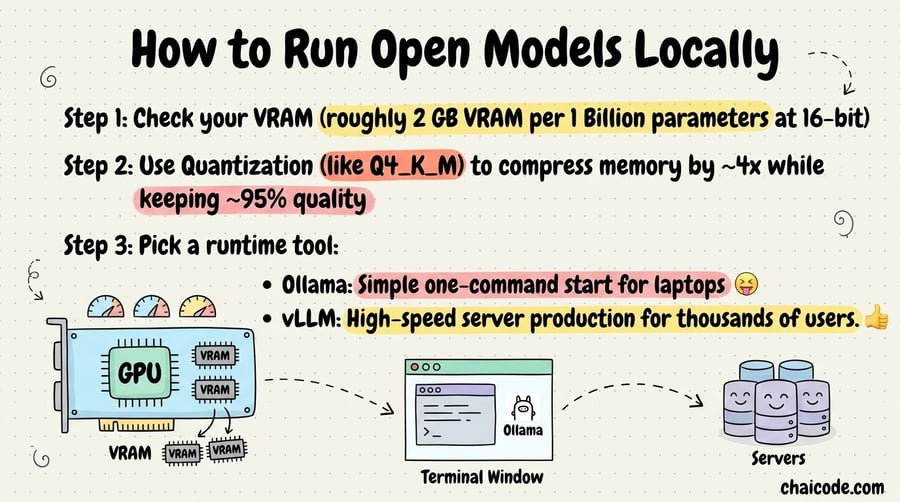
Step 1: Check your VRAM (roughly 2 GB VRAM per 1 Billion parameters at 16-bit)
Step 2: Use Quantization (like Q4_K_M) to compress memory by ~4x while keeping ~95% quality
Step 3: Pick a runtime tool:
• Ollama: Simple one-command start for laptops
• vLLM: High-speed server production for thousands of users.
Open Weights on Managed Cloud
09
Notes
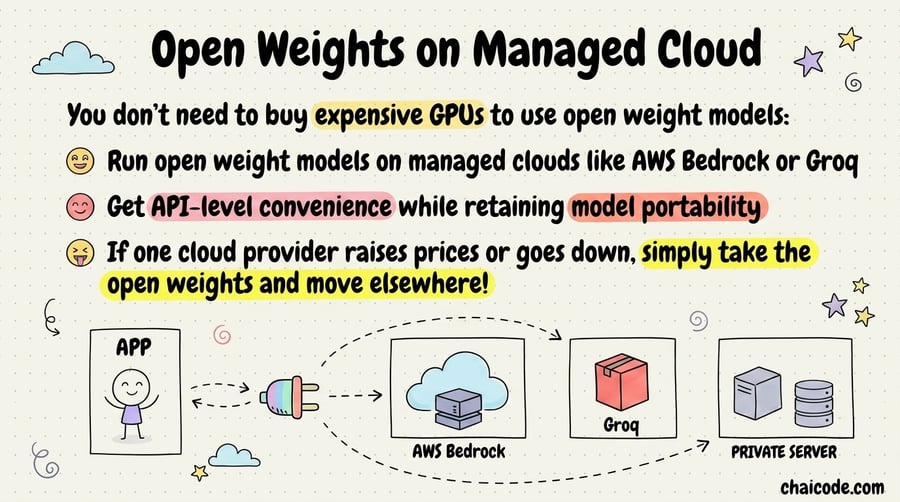
You don't need to buy expensive GPUs to use open weight models:
• Run open weight models on managed clouds like AWS Bedrock or Groq
• Get API-level convenience while retaining model portability
• If one cloud provider raises prices or goes down, simply take the open weights and move elsewhere!
The Economics: What Is Cheaper?
10
Notes
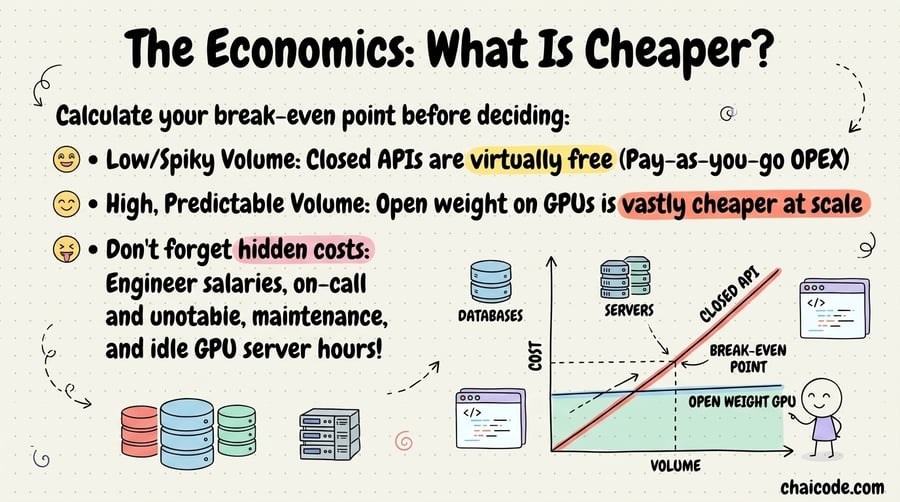
Calculate your break-even point before deciding:
• Low/Spiky Volume: Closed APIs are virtually free (Pay-as-you-go OPEX)
• High, Predictable Volume: Open weight on GPUs is vastly cheaper at scale
• Don't forget hidden costs: Engineer salaries, on-call maintenance, and idle GPU server hours!
The Harness: Engine vs Car
11
Notes
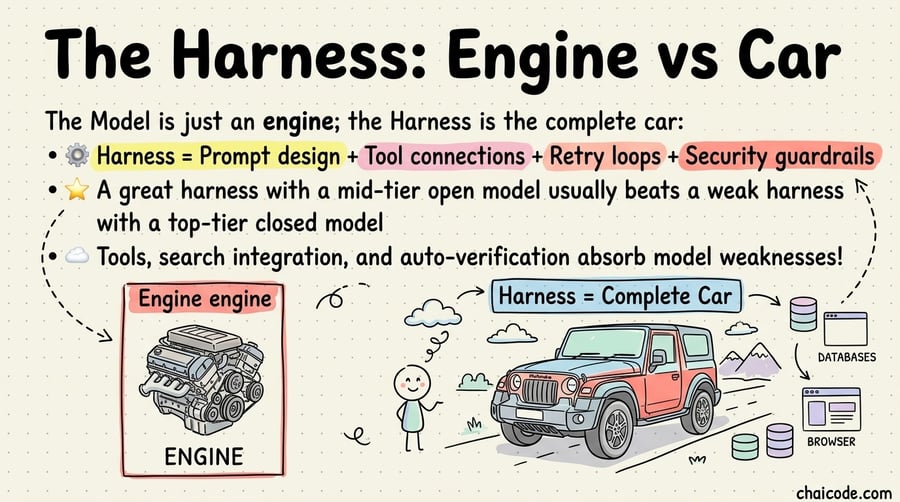
The Model is just an engine; the Harness is the complete car:
• Harness = Prompt design + Tool connections + Retry loops + Security guardrails
• A great harness with a mid-tier open model usually beats a weak harness with a top-tier closed model
• Tools, search integration, and auto-verification absorb model weaknesses!
Golden Rules for AI Builders
12
Notes
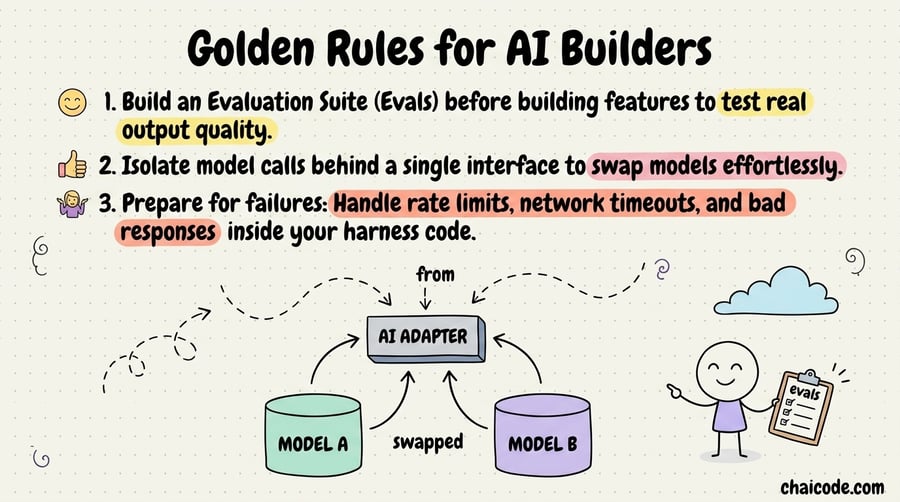
1. Build an Evaluation Suite (Evals) before building features to test real output quality
2. Isolate model calls behind a single interface to swap models effortlessly
3. Prepare for failures: Handle rate limits, network timeouts, and bad responses inside your harness code.